Collection PL

About
118 results · Page 4 of 10
Italy 1871 Standing Italia vignette die proof (PS976)

Italy 1871 — Standing Italia Vignette Die Proof (PS976)

Engraved vignette die proof of 'Standing Italia,' later integrated into the 250 Lire specimen of the Banca Italo-Germanica (1871–72, PS976). The allegory, modeled on classical prototypes, depicts Italia standing with shield and spear, emblematic of the country’s newly achieved unification and Rome’s designation as capital in 1871. Pulled directly from the master plate by Bradbury, Wilkinson & Co., this die proof captures the engraving in its purest state—sharp, uninked margins, and untouched by printing wear. ... Read more →

ItalyVignette1871 Italia AllegoryDie ProofBanca Italo-Germanica250 LireItalian StatesBradbury WilkinsonBWCItaly1871
Held
Italy ND (1868) Banco di Napoli Fede di Credito specimen, ICG 60 AU/UNC

Italy 1868 — Banco di Napoli Fede di Credito 50–200 Lire Specimen (Pick Unlisted)

Specimen Fede di Credito from the Banco di Napoli, engraved by Bradbury, Wilkinson & Co. during the early years of the unified Kingdom of Italy. The Banco di Napoli traced its roots back to charitable institutions founded in 1539, making it one of Europe’s oldest surviving banks. ... Read more →

ItalySpecimen186850–200 LireICG 60 AU/UNC Pick-UnlistedBradbury WilkinsonBWCSpecimenItalian KingdomBanco di Napoli50 lire200 lireItaly1868
Held
Italy 1869 Credito Agricolo della Cassa di Risparmio in Bologna 30 Lire specimen serial number 0001 printed by Bradbury Wilkinson and Company PMG 63 Top Pop

Italy 1869 — Credito Agricolo della Cassa di Risparmio in Bologna 30 Lire Specimen (Pick Unlisted)

Specimen of the 30 Lire issue from the Credito Agricolo della Cassa di Risparmio in Bologna, produced by Bradbury, Wilkinson & Company during the critical early phase of post-unification Italian financial restructuring. The denomination itself—30 Lire—is highly unconventional and appears directly tied to structured agricultural credit mechanisms rather than standard monetary circulation, reflecting targeted rural financing systems implemented in newly unified Italy. Credito Agricolo institutions operated as specialized credit channels designed to stabilize agricultural production and extend liquidity to rural sectors, where fragmented coinage systems and inconsistent monetary supply remained a persistent issue. ... Read more →

ItalySpecimen186930 LirePMG 63 Choice Uncirculated Top Pop Serial Number 0001 SpecimenAgricultural Credit NoteCredito AgricoloCassa di Risparmio in BolognaPrivate Banking InstrumentControlled Credit IssueOdd Denomination30 LireBradbury Wilkinson and CompanySecurity PrintingGuilloche EngravingBlue UnderprintPortrait MedallionIssuance PanelItalian Banking HistoryPost Unification ItalyNineteenth Century FinanceAgricultural Credit SystemHistoryItaly1869Pick UnlistedPMG 63Top PopUniqueR9 Extremely RareMuseum Grade
Held
Italy 1866 Credito Fondiario di Bologna 50 Lire specimen, PMG 66 EPQ

Italy 1866 — Credito Fondiario di Bologna 50 Lire Specimen (Pick Unlisted)

Specimen proof of the 50 Lire issue from the Credito Fondiario di Bologna, engraved by Bradbury, Wilkinson & Co. and dated 1866. Credito Fondiario institutions specialized in long-term, mortgage-backed lending—a key innovation in Italy’s financial system, providing stability and funding for agricultural and urban development at a time when the new Kingdom was still economically fragmented. ... Read more →

ItalySpecimen186650 LirePMG 66 EPQ (Top Pop) OversizedSpecimen ProofProofSpecimenPrivate BankItalian StatesPick UnlistedTop PopPMG 66 EPQ50 lireBradbury WilkinsonBWCItaly1866
Held
Austria 1800 Wiener Stadt Banco 1 Gulden issued note, Pick A29a, typographic Banco-Zettel design with value watermark in Arabic and Roman numerals

Austria 1800 — Wiener Stadt Banco 1 Gulden Issued Note (Pick A29a)

An issued 1 Gulden Banco-Zettel dated 1800 from the Wiener Stadt Banco, catalogued as Pick A29a. This denomination represents the foundation level of Austria’s first large-scale fiduciary paper money system, introduced in 1796 to stabilize state finances during prolonged military conflict and fiscal strain at the end of the eighteenth century. The 1 Gulden occupied a central role in everyday commerce across the Habsburg lands. ... Read more →

AustriaIssued Note18001 GuldenPMG 63 Choice Uncirculated Issued NoteBanco-ZettelFiduciary Paper MoneyEarly State CurrencyTypographic BanknoteWiener Stadt BancoHabsburg Monetary SystemNapoleonic Era FinanceEveryday CirculationGaliciaZłoty ReńskiPolish Language TextAustrian Partition of PolandAustria1800PMG 63 Choice UncirculatedPick A29aMuseum Grade
Held
Austria 1806 Wiener Stadt Banco 10 Gulden issued note, Pick A39a, typographic design with multilingual denomination and value watermark in Arabic and Roman numerals

Austria 1806 — Wiener Stadt Banco 10 Gulden Issued Note (Pick A39a)

The 10 Gulden Banco-Zettel of 1806, issued by the Wiener Stadt Banco and catalogued as Pick A39a, represents the upper operational tier of Austria’s first fiduciary paper money system. Introduced as part of the Banco-Zettel reforms beginning in 1796, these notes were created to finance sustained military conflict and expanding state expenditure during the Napoleonic Wars, at a moment when metallic reserves were insufficient to support the needs of the Habsburg Monarchy. Within the denomination structure, 10 Gulden functioned primarily as a high-value transactional instrument. ... Read more →

AustriaIssued Note180610 GuldenPMG 40 Extremely Fine Issued NoteBanco-ZettelFiduciary Paper MoneyEarly State CurrencyTypographic BanknoteWiener Stadt BancoHabsburg Monetary SystemNapoleonic Wars FinanceMultilingual DenominationImperial AustriaGaliciaZłoty ReńskiPolish Language TextAustrian Partition of PolandAustria1806PMG 40 Extremely FinePick A39aMuseum Grade
Held
Uruguay 1862 Banco de Londres y Rio de la Plata 100 Pesos Pick S245r remainder, unissued and unsigned, engraved by Bradbury Wilkinson & Co., PMG 63 Choice Uncirculated

Uruguay 1862 — Banco de Londres y Rio de la Plata 100 Pesos Remainder (Pick S245r)

Few notes capture the working side of 19th-century banknote production like this 1862 100 Pesos remainder. Printed by Bradbury, Wilkinson & Co. for the Banco de Londres y Rio de la Plata but never signed or issued, it remains an untouched example of Uruguay’s first major British-engraved currency design. ... Read more →

UruguayRemainder1862100 PesosPMG 63 Choice Uncirculated Pick S245rPick S245RemainderBanco de Londres y Rio de la PlataBradbury WilkinsonBWCUruguay 19th Century100 PesosUruguay1862
Held
Uruguay 1872 P. Valdez & Co. Tacuarembo 10 Centesimos unissued note with harvest scene, lith. Bauer, Rincon 72 Montevideo

Uruguay 1872 - P. Valdez & Co., Tacuarembo 10 Centesimos Unissued (Pick Unlisted)

Unissued 10 Centesimos note dated 1 July 1872 from P. Valdez & Co. of Tacuarembo (then San Fructuoso), printed by Lit. ... Read more →

UruguayPrivate Scrip187210 CentesimosRaw (VF est.) UruguayPick UnlistedUnissued NotePrivate ScripEmergency MoneyTacuaremboP. Valdez & Co.F. Bauer LithographyUruguay 19th Century10 Centesimos1872Local Issue
Held
Uruguay 1872 P. Valdez & Co. Tacuarembo 20 Centesimos unissued note with classical vignette, lith. Bauer, Rincon 72 Montevideo

Uruguay 1872 - P. Valdez & Co., Tacuarembo 20 Centesimos Unissued (Pick Unlisted)

Unissued 20 Centesimos note dated 1 July 1872 from P. Valdez & Co. of Tacuarembo (then San Fructuoso), printed by Lit. ... Read more →

UruguayPrivate Scrip187220 CentesimosRaw (VF est.) UruguayPick UnlistedUnissued NotePrivate ScripEmergency MoneyTacuaremboP. Valdez & Co.F. Bauer LithographyUruguay 19th Century20 Centesimos1872Local Issue
Held
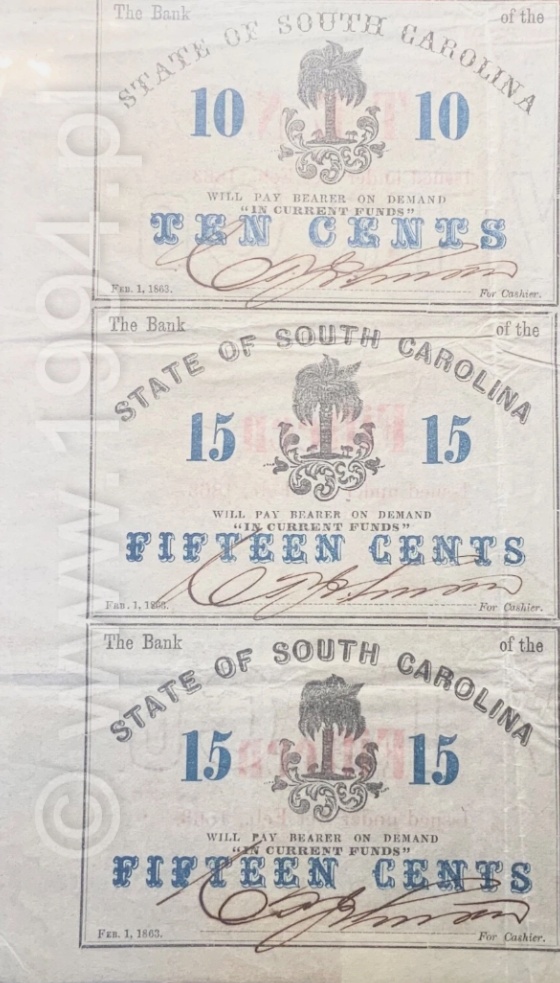
1863 Bank of the State of South Carolina uncut sheet with one 10c and two 15c notes

United States 1863 - Bank of the State of South Carolina 10c and 15c Uncut Sheet of 3

Uncut vertical sheet of three fractional notes from the Bank of the State of South Carolina in Charleston, dated February 1, 1863. The pane contains one 10 cents and two 15 cents notes. These pieces were issued during the Civil War coin shortage under the Act of February 1863 and were payable to bearer in current funds rather than in coin. ... Read more →

United StatesUncut Sheet186310c and 15c (Sheet of 3)Raw (VF est.) Civil WarObsolete CurrencyFractionalSouth CarolinaBank of the State of South CarolinaUncut Sheet10 cents15 centsWalker Evans and Cogswell1863
Held
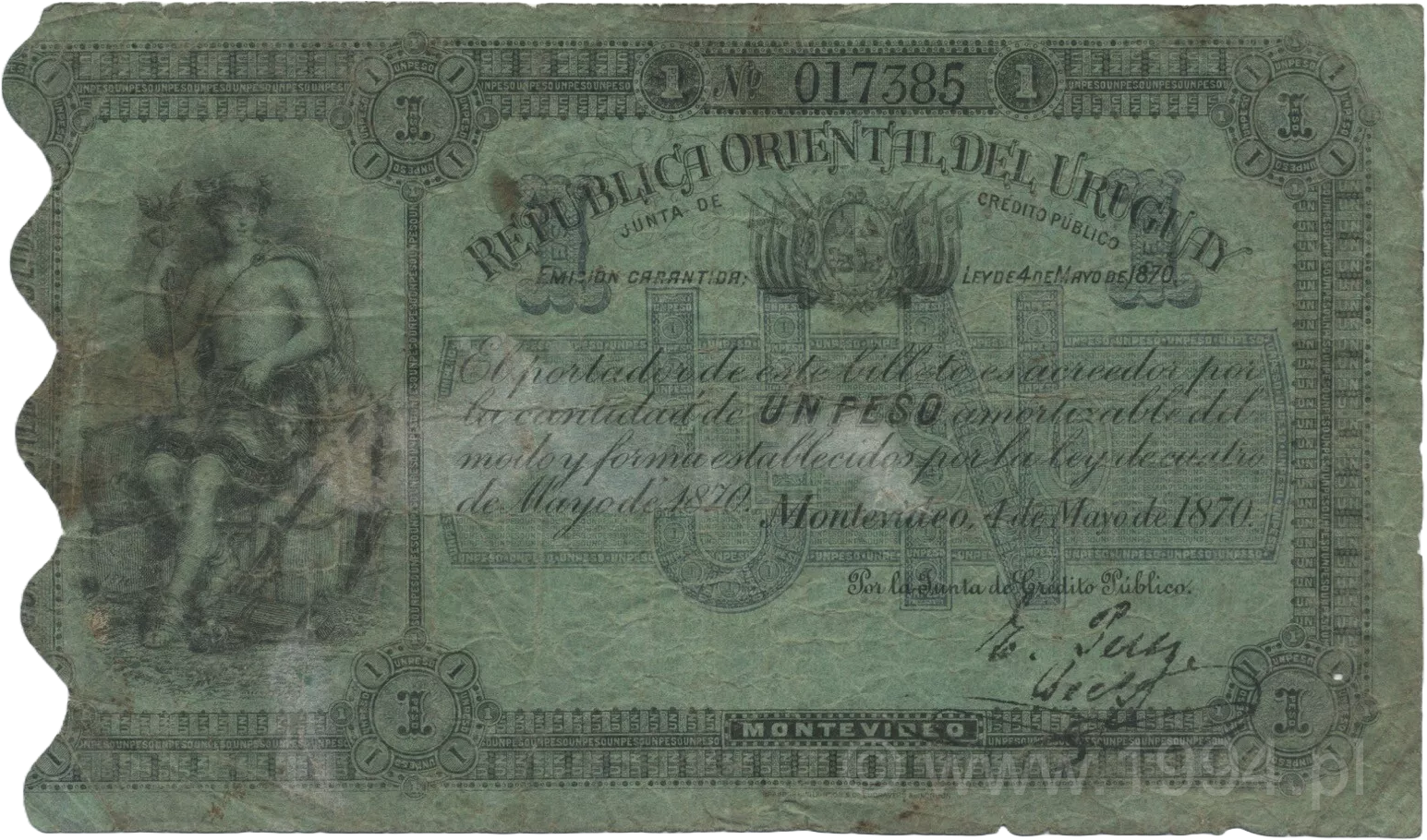
Uruguay 1870 1 Peso Junta de Credito Publico, Signed Ruy West, Serial 017385

Uruguay 1870 — Republica Oriental del Uruguay 1 Peso, Junta de Credito Publico (Signed Ruy / West, Serial 017385)

Earliest emission of the Junta de Credito Publico, dated 4 de Mayo de 1870, representing Uruguay’s first nationally guaranteed paper currency after the financial reform law of the same date. Printed locally in Montevideo by Litografía G. Mas & Cía., the note carries the denomination of 1 Peso, its face tinted green and engraved in fine local intaglio style. ... Read more →

UruguayIssued Note18701 PesoGood – Very Good (est.) Junta de Credito PublicoUruguay1870Hand-Signed1 pesoLocal PrintMercury Allegory
Held
Uruguay 1870 1 Peso Junta de Credito Publico Illegible Signature Variant Serial 710157

Uruguay 1870 — Republica Oriental del Uruguay 1 Peso, Junta de Credito Publico (Illegible Signature Variant, Serial 710157)

Dated 4 de Mayo de 1870, this 1 Peso note represents the same first national issue of the Junta de Credito Publico but bearing a different handwritten signature type, executed by another board member whose autograph remains partially illegible due to cancellation and ink staining. The printing is identical to the 'Ruy / West' variety, featuring Mercury seated left, Uruguay’s arms top center, and the text 'Ley de 4 de Mayo de 1870'. The green paper stock and scalloped margin are characteristic of local lithography by G. ... Read more →

UruguayIssued Note18701 PesoGood (Cancelled, est.) Junta de Credito PublicoUruguay1870Hand-Signed1 pesoLocal PrintCancellation
Held
↑ Top